24 beliefs in FEA: ask four questions and most errors never happen

For five weeks, every working day, one sentence went up on LinkedIn, the kind that gets said in design reviews in one form or another. "Then we'll just use a stronger steel." "Red means critical." "Below the yield strength nothing can happen." 24 beliefs, each put to the numbers, and beneath them several hundred comments from analysts, test engineers, professors and design engineers.
Reading back through them, one thing stands out: none of the 24 beliefs fails at the math. All of them fail at one of four questions that was not asked before the analysis. That is the good news. There is a lot that can go wrong in FEA, but it is always the same few things, and they can be caught with habits rather than theory.
Who this text is for. Anyone deciding whether the design team may run its own analyses will find the four questions a team needs as its standard. Anyone just starting out will find three habits that make the most common errors visible before someone else finds them. Anyone already running analyses will find the objections from the comments.
Why the fear is bigger than the risk
Under one of the first posts a lecturer asked: "If someone does not have these things at hand in simulation, should they be running simulations at all?" The series' answer: as early as possible, but with guidance. Three things take the edge off getting started.
- The dangerous errors are the visible ones. A bracket supported upside down moves the wrong way in the deformation plot. Whoever looks at the deformation first finds errors like that in seconds, without a formula.
- Deviation is normal. In practice, analysis and measurement typically sit ten to twenty percent apart. A model does not have to land on the exact value, but its deviation has to be one you can name.
- Linear is usually enough. The simple, linear analysis is on the safe side in most cases. Only three warning signs call for more: a deflection larger than the sheet thickness or one that visibly changes the lever arm, compression in a slender member, and a load that returns.
Four questions, 24 beliefs
- Stiffness or strength? Is the question how far something moves, or whether it holds?
- Does the model check itself, or does someone check it from outside? Convergence, plausibility and error messages say something about the analysis, nothing about the part.
- What does the number in the plot mean? Red, maximum, equivalent stress, safety factor: each of these has a scale, and the scale is not in the picture.
- What does the yield strength tell you, and what doesn't it? Below it a part still buckles and still fatigues; above it, yielding is not yet failure.
Each of these questions fits in two lines, and most of them can be answered with a linear analysis, provided the tool takes care of mesh, convergence and tolerance band. That is how Dr.Q works: the questions stay with the design engineer, so does the judgement, and the part in between runs in the browser.
Question 1: stiffness or strength?
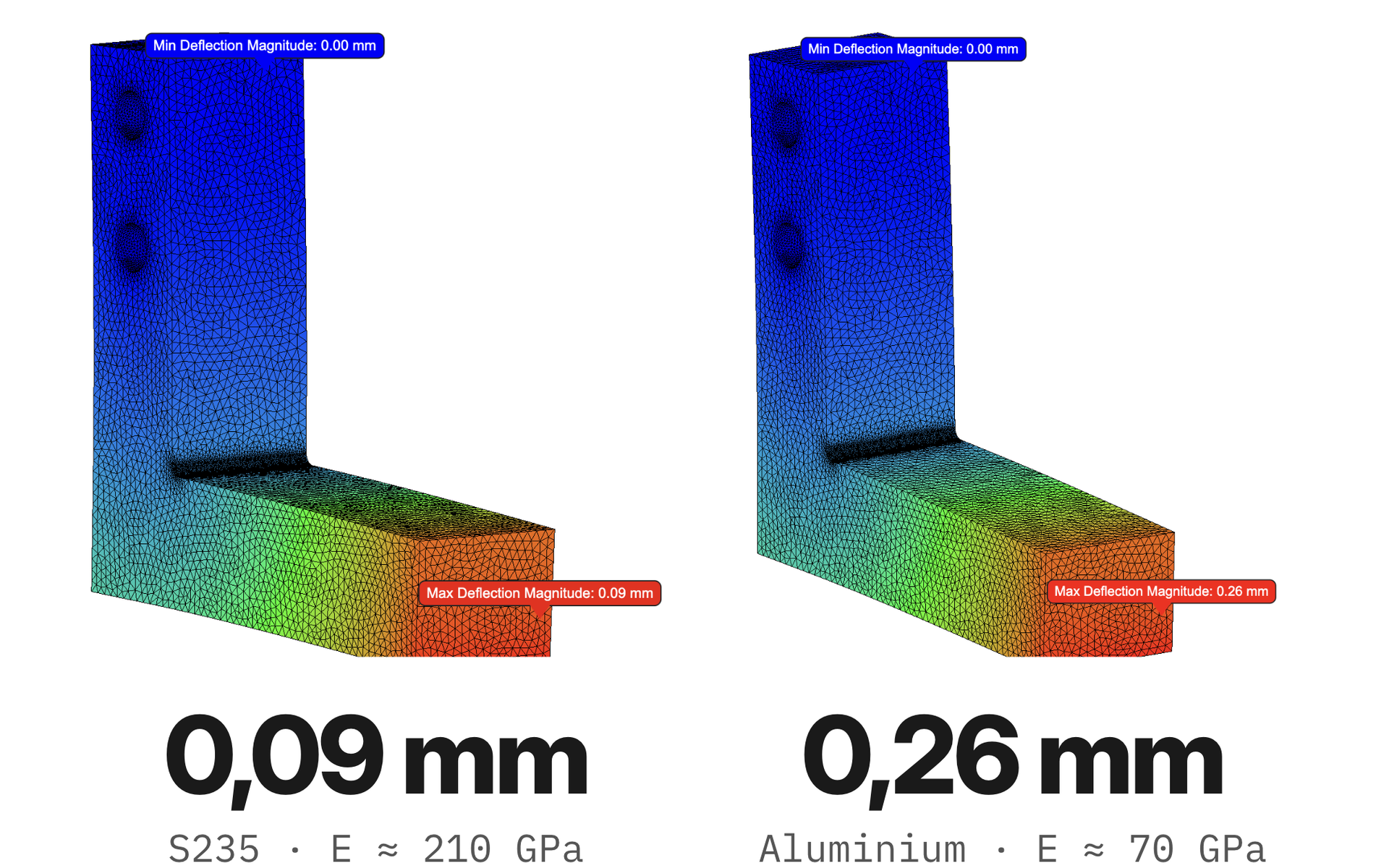
A bracket made of S235 deflects 0.09 mm under load, too much for its function. Switching to 42CrMo4 brings almost four times the yield strength, and the deflection stays at 0.09 mm, because it depends on the Young's modulus, and that is around 210 GPa for practically every steel. The same bracket in aluminium deflects almost three times as far, and at the notch both show the same stress of 175 MPa. For "Does it hold?" you look at the stress; for "Does it work?" you look at the displacement. The same goes for buckling: the buckling load contains the Young's modulus, the cross-section, the length and the support, and not the strength.
Question 2: does the model check itself, or does someone check it from outside?
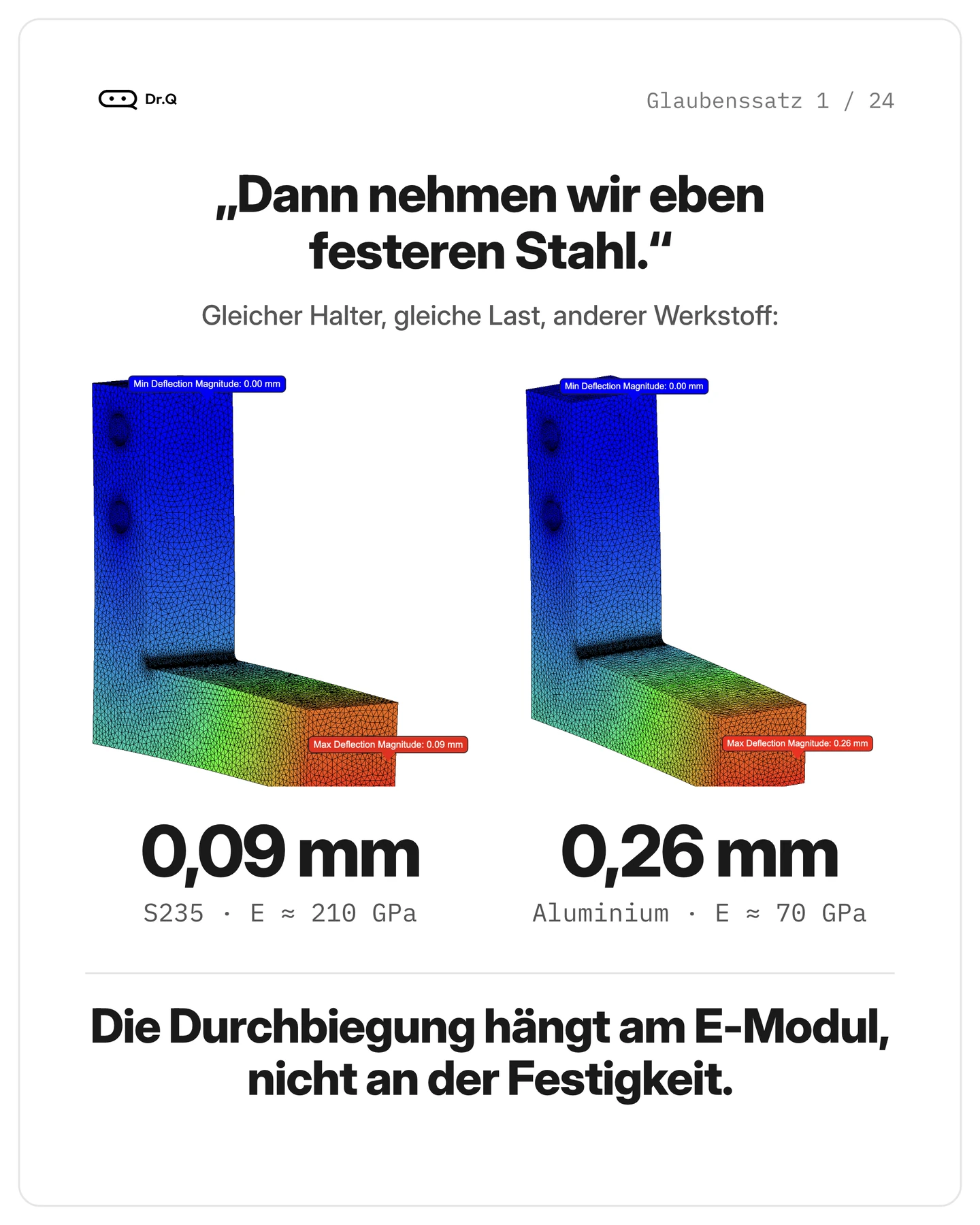
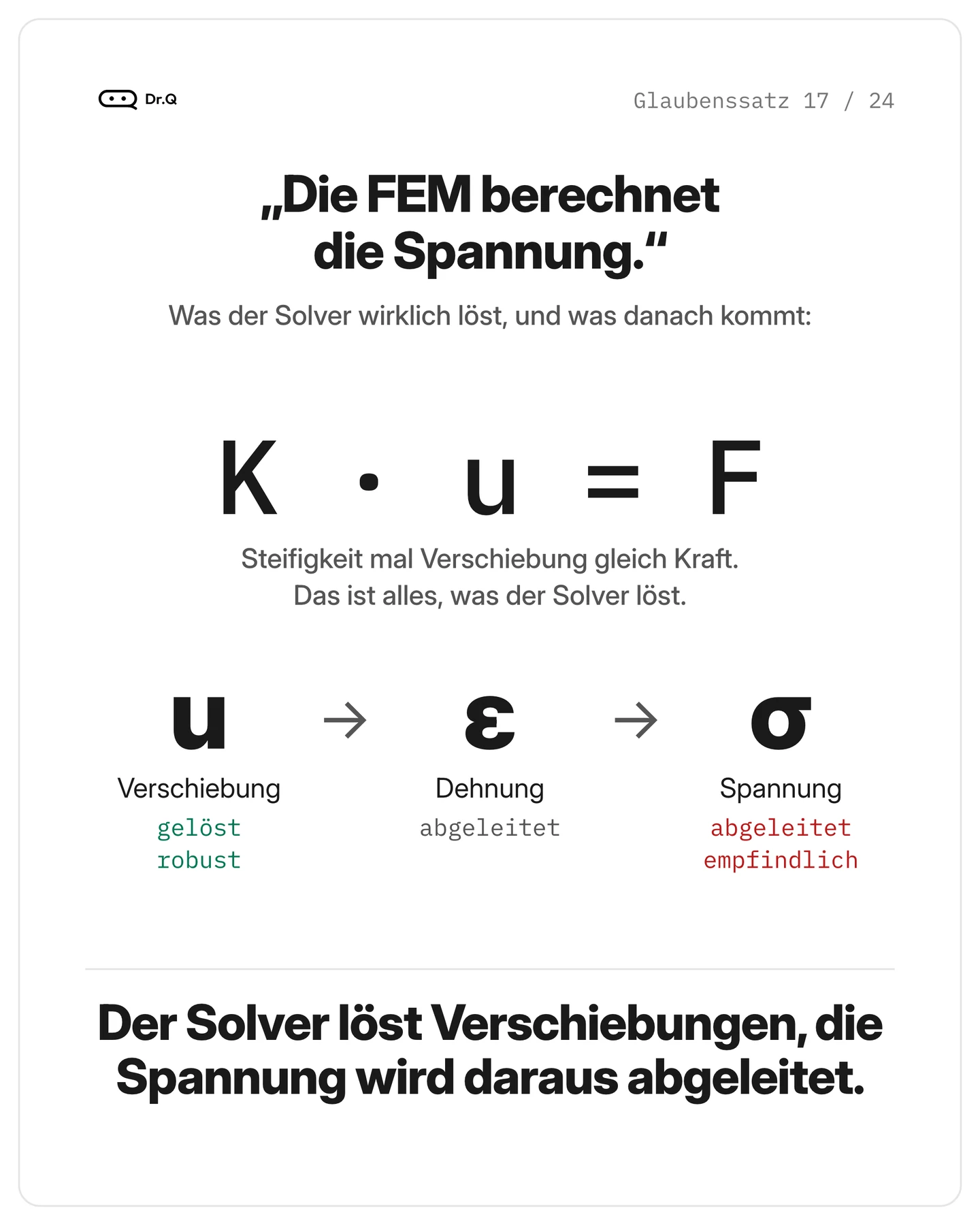
The same bracket was analysed three times. In the first model the clamping and the load were swapped, in the second the load acted sideways instead of downwards, and only the third was supported and loaded the way the part will be once installed. All three ran through without a warning, at 60, 177 and 175 MPa, and only the third result is right. The solver solves K·u = F, stiffness times displacement equals force, and with that it checks mathematics, not physics. What gets solved is the displacement. Stress and strain are derived from it, which is why you check the deformation first and the stress second.
A professor of mechanics added a sentence from his first years on the job in the comments: "You can find a plausible explanation for any result." That is why the hand calculation is not a rival to FEA but its guardian: if the deflection is already completely wrong, the stress from the same model cannot be saved.
Convergence and plausibility only check the model against itself; that is verification. Whether the model computes the right thing is shown only by the comparison with reality, and that is validation. Verified is not yet validated. The head of a structural test department described in the comments what that looks like in aerospace: "The aim is to replace the final full-scale structural test with these credible simulations." Material specimens, joints and friction pairs are tested for that, and the analysis builds on their data. On measurement, the post with the most comments, he added a rule that appeared in none of the posts: "Only when the two uncertainty bands do not overlap is the deviation a systematic finding, either for the model or for the test setup." That is why Dr.Q reports every result with its tolerance band from the convergence study.
Question 3: what does the number in the plot mean?
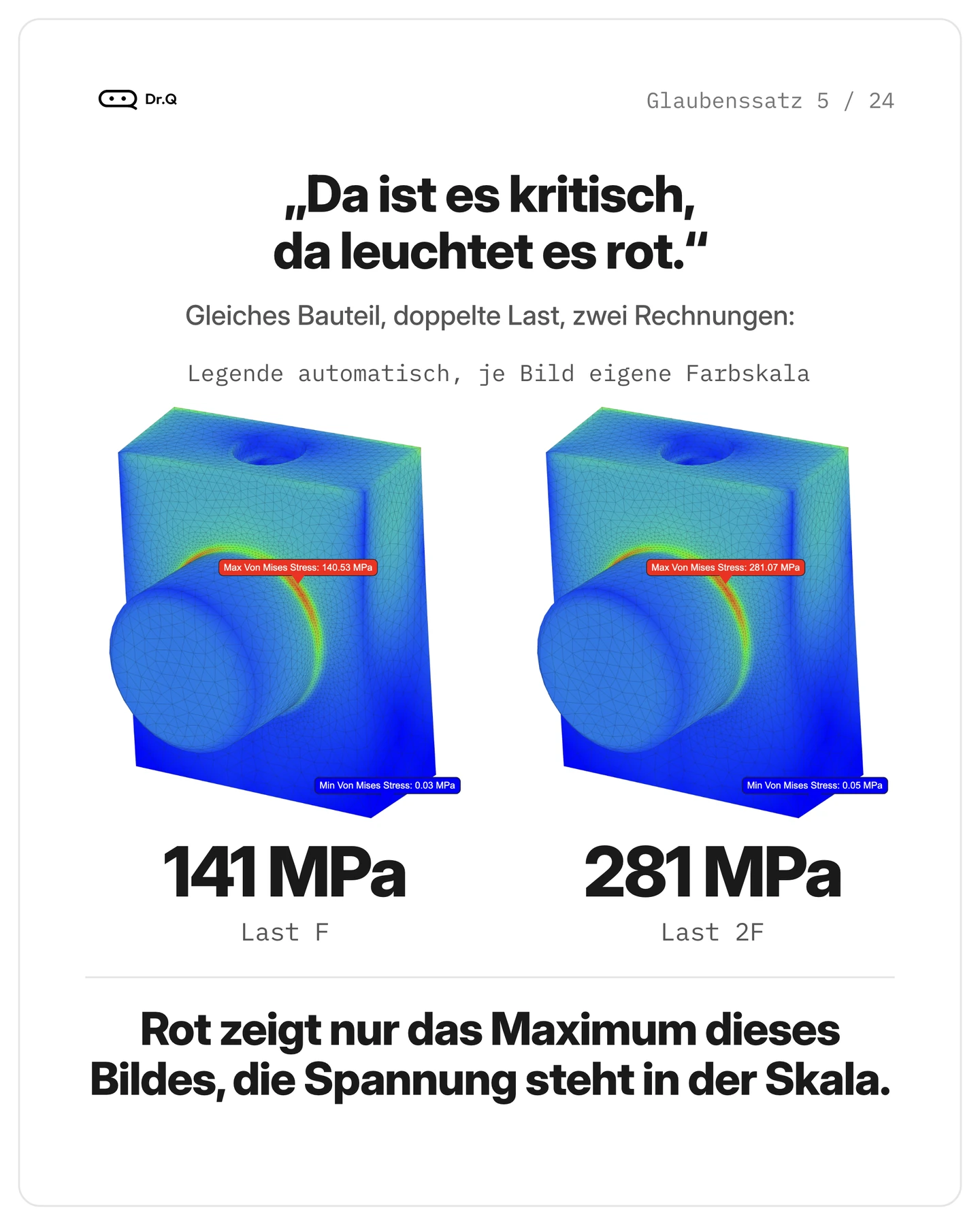
The same part was analysed once with the force F and once with 2F, and the two plots cannot be told apart. On the left the maximum reads 141 MPa, on the right 281, and both times the same spot is red. So red is only the maximum in the plot. A simulation engineer from the industry wrote: "In aerospace we almost always fix the scale, at the yield strength or the allowable stress."
The same applies to the mesh. At a real location the stress settles at a fixed value as the mesh gets finer; at a sharp edge or a point load it keeps rising without limit. A simulation engineer summed up the rule in the comments: "Refine the mesh and see whether the stress settles or keeps rising. If it keeps rising, it is a singularity." In Dr.Q that refinement runs automatically as a convergence study, and the tool points out when a location does not settle.
Question 4: what does the yield strength tell you, and what doesn't it?
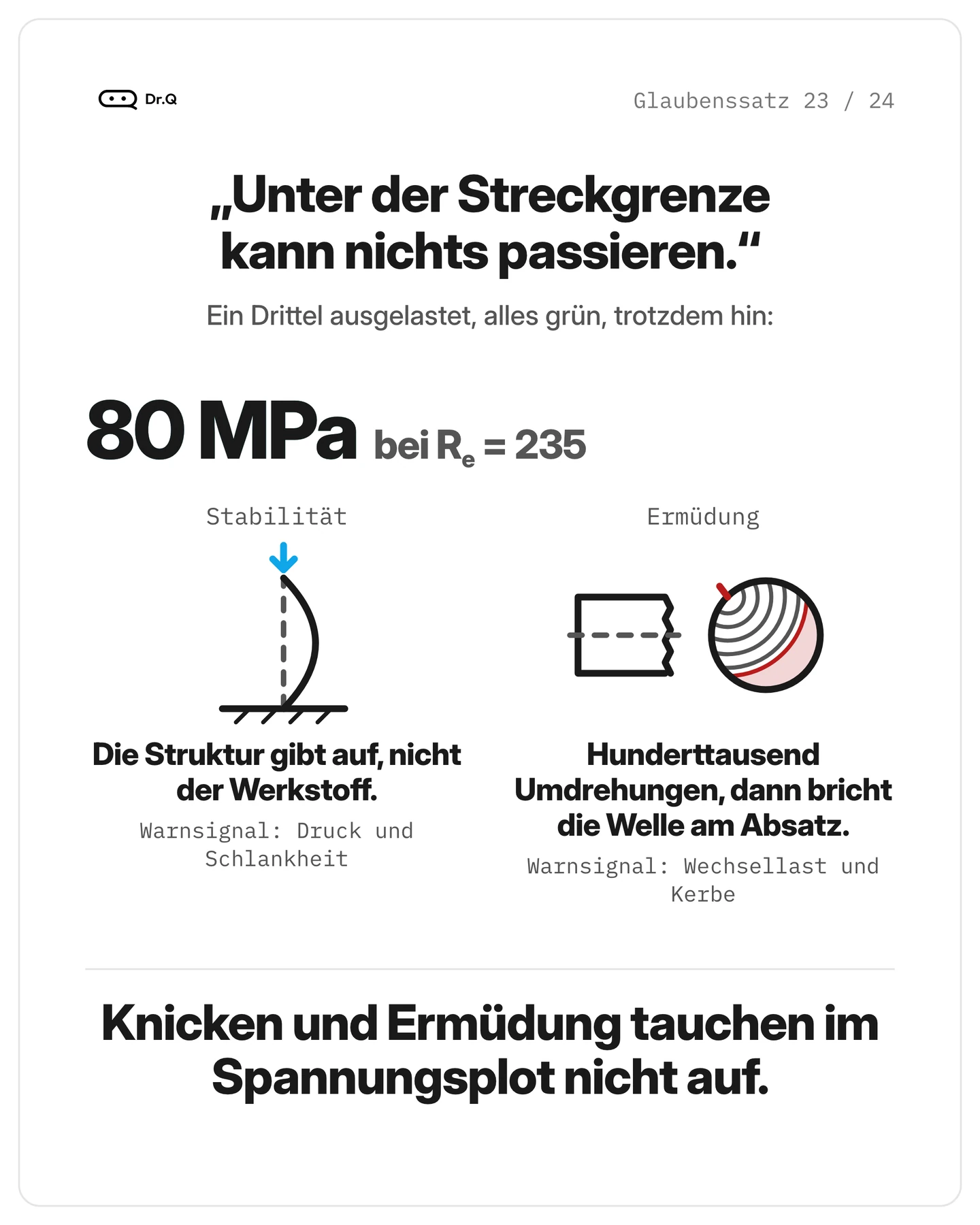
A part at 80 MPa with a yield strength of 235 is loaded to a third, all green, and still fails when a slender strut snaps sideways or a notched shaft breaks after a hundred thousand revolutions. Buckling and fatigue do not appear in the stress plot. Conversely, a spot above the yield strength is not yet failure, because ductile steels are forgiving about local yielding. The plastic analysis, as one stress engineer put it in the comments, is "not the lifeline for calculating the design into compliance after all", because the tabulated values are minimum values and the flow curve is an assumption.
Three habits to start with
- Check the deformation first. Does the part move like the real part, and does the load act where it acts in reality?
- Make a hand estimate. Deflection or reaction force, and compare the result against it. If it is off by a multiple, fix the model first, not the mesh.
- Fix the scale, watch the change. Fix the scale at the yield strength, and red means the same thing in every plot. At a peak, what counts is the change between two mesh levels, not the value.
What this means for the design review
Not everyone in a design review has to be able to run an analysis, but everyone should ask the same questions of a result. Then the room talks about the part instead of the colour, and the simulation team is free for the cases that need its experience. A lead engineer described in the comments how it runs on his side: the results go out to everyone a day ahead, and "only once the expert has set the frame and named the real weak spots do we go into the joint discussion".
The checklist: 14 questions and all 24 beliefs with their answers
The PDF contains a checklist to tick off, 14 questions before and after the analysis, together with all 24 beliefs with their answer and check question, and every card of the series. A larger company had asked for exactly such a list in conversation beforehand, as a standard for the whole team.
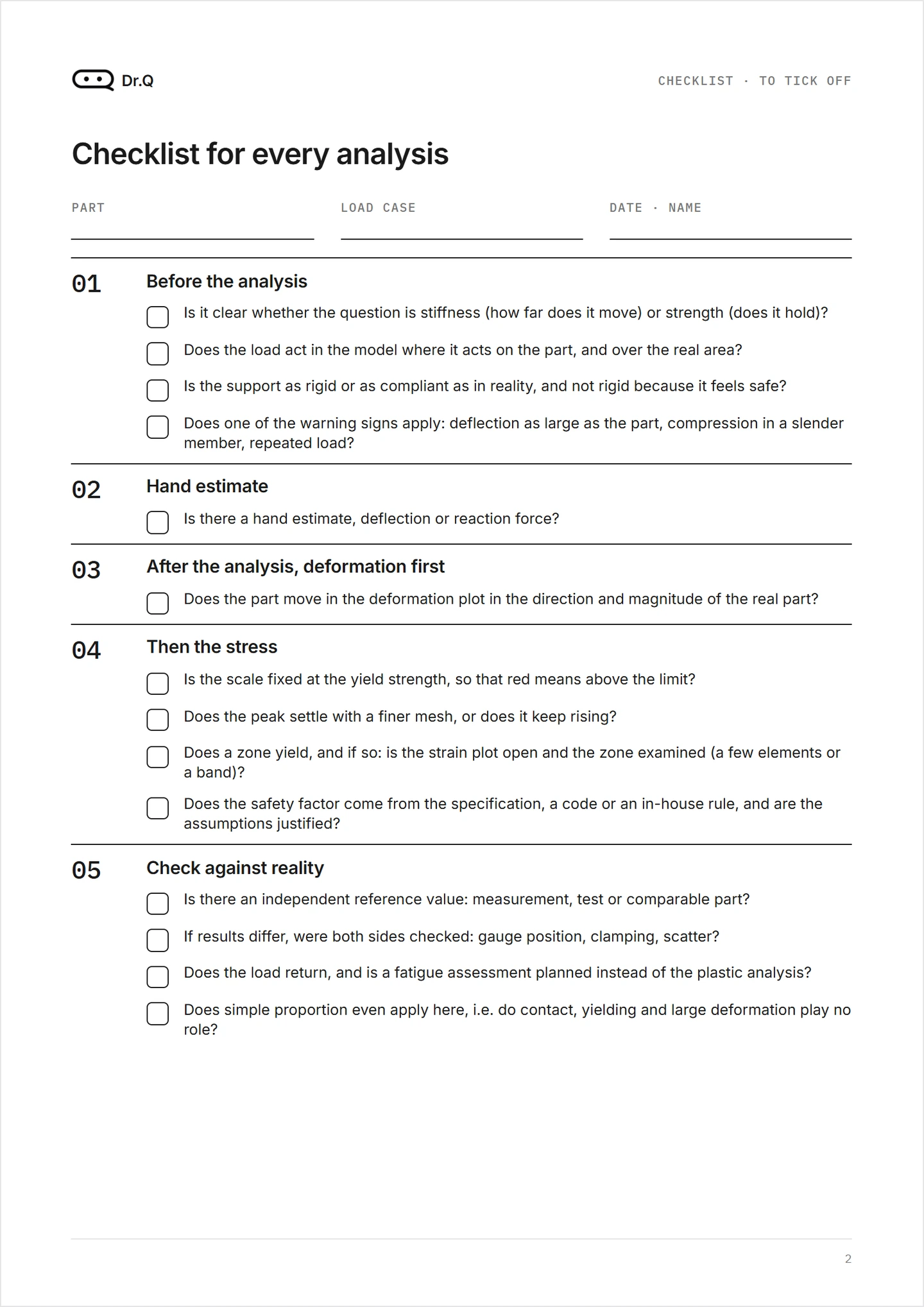
The checklist as a PDF.
14 questions before and after the run, all 24 beliefs with their answers and every card of the series. The download is ready after submitting.
Run the numbers instead of believing
Anyone who wants to check one of the 24 questions on a part of their own does not need to be an expert and does not need weeks of training. Upload the part, describe support and load in words, and Dr.Q runs a linear analysis with an automatic convergence study and returns the result in the browser. Whether the part holds is still decided by a person, and Dr.Q supports wherever it can.
And anyone who knows a 25th belief this series is missing: the comments under the closing post on LinkedIn are open.